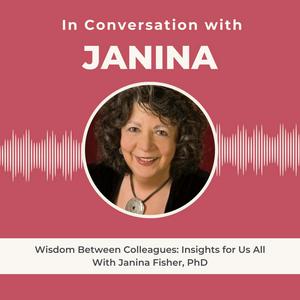
PodcastSalute e benessereIn Conversation with Janina Fisher: Wisdom Between Colleagues; Insights For Us All

In Conversation with Janina Fisher: Wisdom Between Colleagues; Insights For Us All

Janina Fisher, PhD
In Conversation with Janina Fisher: Wisdom Between Colleagues; Insights For Us All
Ultimo episodio

22 episodi

  • In Conversation with Janina Fisher: Wisdom Between Colleagues; Insights For Us All

    When Families Break Apart: Estrangement, Attachment, and the Possibility of Repair

    22/04/2026 | 42 min
    In this episode of In Conversation with Janina Fisher, Janina Fisher welcomes therapist, educator, and estrangement specialist Matthias Barker for a thoughtful exploration of family estrangement, attachment wounds, and the possibilities for healing across painful divides.
    Drawing on his work with thousands of parents and adult children through Estrangement.com, Barker shares what he has learned about the growing phenomenon of family cutoffs and the emotional dynamics that often lie beneath them. Together, he and Dr. Fisher explore why repairing estranged relationships is rarely about resolving a single conflict. Instead, healing requires addressing deeper attachment injuries, misunderstandings, and the unsafe emotional environments that shaped the relationship over time.
    Reflective and deeply human, this episode offers clinicians and listeners alike a nuanced look at how empathy, accountability, and emotional safety can open the door to healing—even after years of distance.
    Key Takeaways
    Estrangement often reflects deeper attachment wounds. Family cutoffs are rarely caused by a single incident; they usually grow from unresolved emotional injuries within the relationship.

    Healing must precede reconciliation. Barker emphasizes that the goal is not simply to restore contact, but to support each person in doing their own internal healing work first.

    Shifting from “the story” to “the struggle.” Moving away from debating facts or blame allows families to acknowledge the underlying emotional pain that fuels conflict.

    Psychoeducation creates a neutral foundation. Learning about attachment patterns, trauma, and relational dynamics can help families step out of polarized “parent vs. child” narratives.

    Witnessing transforms understanding. Hearing others’ stories in a group setting can soften defenses and create unexpected empathy between estranged family members.

    Trauma is about environment, not just events. Fisher highlights that trauma often arises from living in chronically unsafe emotional environments—not only from specific incidents.

    Repair is possible through accountability and emotional safety. When family members acknowledge pain and respond with empathy, new relational pathways can begin to emerge.

    Show Notes:
    Website: 
    estrangement.com
    Bio:
    Matthias Barker, LMHC, is a psychotherapist and founder of Estrangement.com, an online psychoeducation and support program for parents and adult children navigating long-term family disconnection. His work centers on illuminating the relational dynamics that sustain rupture or open pathways toward healing and repair. He has become one of the most widely followed voices on family estrangement in the world, reaching an audience of over four million people across social media and podcast platforms.
    His training is integrative and draws from extended apprenticeships across several major therapeutic traditions. He trained in grief and loss under David Kessler, who co-authored multiple works with Elisabeth Kübler-Ross; in Internal Family Systems under Dr. Frank Anderson, the Harvard-trained psychiatrist who co-authored the IFS Skills Training Manual with the model’s originator, Richard Schwartz; and in Acceptance and Commitment Therapy and Relational Frame Theory under Dr. Matthieu Villatte, who co-authored Mastering the Clinical Conversation with ACT co-developer Steven C. Hayes. He contextualizes these modalities through attachment research and conflict theory, including the work of the Gottmans and Emotionally Focused Therapy.
    He is currently conducting research on the patterns and pathways to healing that have emerged from his work with families, and is writing a book on the subject. He lives in Nashville with his wife and three children.
  • In Conversation with Janina Fisher: Wisdom Between Colleagues; Insights For Us All

    Healing Through Connection: Attachment, Family, and the Power of Relationship

    15/04/2026 | 51 min
    In this episode of In Conversation with Janina Fisher, Janina sits down with clinician, author, and attachment specialist Dafna Lender, LCSW, to explore the power of relationships in healing trauma—especially for children and families. Known for her work with TheraPlay and her book Integrative Attachment Family Therapy, Dafna shares the personal and professional journey that shaped her approach to therapy.
    Together, Janina and Dafna reflect on how attachment disruptions and early relational trauma affect emotional development, and why healing must often involve not only the individual child but the entire family system. Their conversation highlights the importance of play, attunement, and embodied connection in helping children feel safe enough to heal. They also discuss how clinicians can support caregivers in becoming active partners in the therapeutic process, fostering deeper connection and long-term change.
    Warm, thoughtful, and deeply human, this dialogue invites listeners to consider how connection, curiosity, and relationship remain at the heart of effective trauma treatment—for therapists, families, and the children they serve.
    Key Takeaways
    Healing developmental trauma often requires working with the entire family system, not just the child.

    Attachment and relational safety are foundational for emotional regulation and growth.

    Play and experiential interactions can help children access connection and healing in ways that traditional talk therapy cannot.

    Supporting and empowering caregivers is essential to creating lasting change for children.

    Integrating body-based and attachment-focused approaches helps clinicians address trauma at both relational and physiological levels.

    Bio:
    Dafna is a family therapy expert and attachment specialist. Dafna is an international trainer and supervisor for practitioners who work with children and families. She is a certified trainer and supervisor/consultant in both Theraplay® and Dyadic Developmental Psychotherapy (DDP), as well as an EMDR therapist.  Dafna’s expertise is drawn from 29 years of working with families in many settings: at-risk after school programs, therapeutic foster care, in-home crisis stabilization, residential care and private practice. Dafna’s style, whether as a therapist or teacher, is combining the light-hearted with the profound by bringing a playful, intense and passionate presence to every encounter. 
    Dafna is author of Integrative Attachment Family Therapy (2023) and the co-author of Theraplay the Practitioner’s Guide (2020).  She teaches and supervises clinicians in 15 countries in 4 languages: English, Hebrew, French and Spanish.  

    Website:https://www.dafnalender.com/

    Book: Integrative Attachment Family Therapy: A Clinical Guide to Heal and Strengthen the Parent-Child Relationship through Play, Co-regulation, and Meaning-Making
  • In Conversation with Janina Fisher: Wisdom Between Colleagues; Insights For Us All

    Every Memory Deserves Respect: The Art of Working with Trauma and EMDR

    08/04/2026 | 44 min
    In this episode of In Conversation with Janina Fisher, Janina sits down with psychologist and EMDR pioneer Deborah Korn for a rich conversation about the evolution of trauma treatment and the delicate art of working with traumatic memory. Known for her thoughtful and compassionate approach to EMDR therapy and for her book Every Memory Deserves Respect, Debbie reflects on the clinical lessons that have shaped her decades of work with trauma survivors.
    Together, Debbie and Janina Fisher explore what it means to approach traumatic memories with respect, patience, and humility. Debbie shares insights from her experience using EMDR with complex trauma, emphasizing the importance of pacing, preparation, and careful attunement to clients’ nervous systems. Their conversation highlights the ways therapists can support healing while avoiding overwhelm—helping clients process painful experiences without losing a sense of safety or stability.
    Through personal stories and clinical reflections, Debbie discusses the responsibility therapists carry when guiding clients through trauma work, as well as the importance of curiosity, flexibility, and deep respect for each client’s inner experience. The result is a thoughtful dialogue about how trauma therapy continues to evolve and how clinicians can remain grounded in compassion while doing this powerful work.
    Key Takeaways
    Every traumatic memory deserves respect. Trauma work requires careful pacing, sensitivity, and deep respect for the protective role memories and symptoms have played in a client’s life.

    Preparation is essential in trauma treatment. Stabilization, resource-building, and strong therapeutic alliance create the safety needed for effective trauma processing.

    EMDR can be powerful for complex trauma when used thoughtfully. Skilled clinicians must adapt protocols and pace the work according to the client’s nervous system and capacity.

    Therapists must balance courage with caution. Trauma processing requires both clinical confidence and humility about the risks of moving too quickly.

    Attunement guides the work. The therapist’s ability to notice shifts in the client’s body, emotions, and parts of self helps determine when to move forward and when to slow down.

    Healing unfolds through collaboration. The most effective trauma therapy happens when therapist and client work together with curiosity, respect, and patience.

    Deborah L.  Korn, PsyD maintains a private practice in Cambridge, MA and is on the training faculty of the Trauma Research Foundation and the EMDR Institute.  Dr. Korn has authored numerous articles and chapters focused on EMDR therapy, including comprehensive reviews of EMDR applications with Complex PTSD. She is an EMDR International Association-approved consultant and is also on the Editorial Board of the Journal of EMDR Practice and Research. She presents and consults internationally on the treatment of adult survivors of childhood abuse and neglect and recently released Every Memory Deserves Respect—a book about EMDR therapy, written for the layperson.   
    Website:
    https://www.everymemorydeservesrespect.com/
    Book:
    https://www.everymemorydeservesrespect.com/
    Please promote this program:

     https://www.cape.org/courses/emdr-therapy-debbie-korn-2026
  • In Conversation with Janina Fisher: Wisdom Between Colleagues; Insights For Us All

    Grief, Trauma, and the Search for Meaning

    01/04/2026 | 31 min
    In this moving conversation, trauma therapist Janina Fisher speaks with grief expert David Kessler about the evolving understanding of grief and its deep connection to trauma. Reflecting on his work with Elisabeth Kübler-Ross and his own personal loss, Kessler shares how the concept of a sixth stage of grief—meaning—emerged. Together, they explore why grief is never linear, how compassion supports healing, and how loss can gradually be integrated into a life that continues to hold love, purpose, and connection.
    Key Takeaways:
    Why grief is not a linear process

    The meaning behind the “sixth stage” of grief

    How trauma and loss intersect in healing

    Why compassion and connection matter in grief recovery

    David Kessler is one of the world’s foremost experts on grief and loss. His decades of experience with thousands of people on the edge of life and death has taught him the secrets to living a happy and fulfilled life, even after life’s tragedies. He is the author of seven books including his latest bestselling book, Finding Meaning: The Sixth Stage of Grief, as well as a new Finding Meaning Companion Workbook. He co-authored two books with Elisabeth Kübler-Ross, Life Lessons and On Grief and Grieving. He co-wrote You Can Heal Your Heart with Louise Hay and also wrote Visions, Trips and Crowded Rooms: Who and What You See Before You Die. His first book, The Needs of The Dying received praise from Saint (Mother) Teresa. His new online model of grief support, Tender Hearts, offers over twenty-five online grief groups.  David leads one of the most respected Grief Educator Certification programs. He is the founder of Grief.com.

    show notes
    website  
    Grief.com

    social media 
    instagram@Iamdavidkessler
    facebook@Iamdavidkessler
  • In Conversation with Janina Fisher: Wisdom Between Colleagues; Insights For Us All

    Implicit States, Future Selves & the Rain Cloud of Knowing: Janina Fisher in Conversation with Nancy Napier

    04/03/2026 | 43 min
    In this tender, wise, and delightfully expansive conversation, Janina Fisher reunites with longtime colleague, author, hypnotherapist, and teacher Nancy J. Napier—whose book Getting Through the Day shaped a generation of trauma clinicians and clients.
    Together, they explore the evolution of their work across four decades: implicit states, parts, SE, hypnosis, spirituality, multidimensionality, and the deep privilege of accompanying clients back into their wholeness. Nancy shares the origins of her “future self” and “alternate self” work, her grandmother’s teaching of the rain cloud of knowable things, and how ideas emerge collectively across time. Janina reflects on why naming, noticing, and staying with implicit states is at the heart of healing.
    Whether you’re a therapist, a client, or someone who loves Nancy’s or Janina’s work, this episode is a warm, soulful exploration of healing, wholeness, and what it really means to grow over a lifetime.
    Implicit states are young body–mind states Nancy and Janina describe implicit states as pre-verbal, deeply embodied experiences carried by young parts of self. The clinical task is to help the adult nervous system stay present with those states, not become them.

    Naming and noticing implicit states is itself an intervention The “noticing brain,” a term Nancy adopted from Janina, helps clients observe rather than drown in their experience. Noticing activates regulation, calms the amygdala, and brings more presence online.

    Spirituality belongs in the therapy room Nancy shares how many clients historically had no safe place to speak about their spiritual lives without being pathologized. Both she and Janina affirm that spirituality and trauma work naturally intersect.

    Future selves and alternate selves offer new templates for living Nancy’s “future self” and “alternate self” processes emerged from teaching, intuition, and synchronicity—what her grandmother called a “rain cloud of knowable things.” These practices help clients embody new possibilities, not just think about them.

    Love and gratitude as healing frequencies Nancy frames love as a universal healing frequency and encourages daily gratitude toward the body and its “community of non-human entities,” as well as toward protective parts. Janina echoes the importance of thanking parts that helped clients survive.

    Implicit healing changes how we grieve later in life Nancy shares how metabolizing an early implicit state of “I’m shattered” transformed her later grief over losing her cats—shifting from overwhelming, childlike collapse to grounded adult mourning.

    Trauma therapy requires active guidance and co-regulation Both clinicians push back against overly neutral, hands-off models. They emphasize that trauma clients are “lost in the trauma world” and need the therapist’s nervous system, structure, and guidance to find their way out.

    Nancy J. Napier, LMFT, is a psychotherapist and hypnotherapist in private practice in New York City, specializing in trauma resolution. She is author of Recreating Your Self: Increasing Self-Esteem Through Imaging and Self-Hypnosis; Getting Through the Day: Strategies for Adults Hurt as Children; Sacred Practices for Conscious Living, and co-author of Meditations & Rituals for Conscious Living.

    She also has recordings of guided meditations on subjects including accessing your optimal future self, mindfulness, healing wounded child parts, and healing shame, to mention a few that may be downloaded from iTunes and CDBaby.  She also has training videos for professionals on Vimeo.com Videos on Demand. In addition, she posts a monthly audio guided meditation on her website, www.nancynapier.com, as well as on her YouTube channel, along with “Videos on Multidimensional Living”, as well as videos from talks given on issues related to spirituality.
Altri podcast di Salute e benessere

Su In Conversation with Janina Fisher: Wisdom Between Colleagues; Insights For Us All

In Conversation with Janina Fisher features intimate, unscripted dialogues between Dr. Janina Fisher and leading voices in trauma therapy. Each episode explores the nuances of healing—from attachment wounds and somatics to IFS, memory reconsolidation, and anti-oppressive care. Thoughtful, relational, and deeply human, these conversations offer insight and inspiration for clinicians and curious minds alike.

Sito web del podcast

Ascolta In Conversation with Janina Fisher: Wisdom Between Colleagues; Insights For Us All, Il Giardino della Meditazione e molti altri podcast da tutto il mondo con l’applicazione di radio.it

Scarica l'app gratuita radio.it

  • Salva le radio e i podcast favoriti
  • Streaming via Wi-Fi o Bluetooth
  • Supporta Carplay & Android Auto
  • Molte altre funzioni dell'app