

Ascolta questo podcast gratuitamente nell'applicazione: Scarica gratuitamente dall'App Store
radio.it
Sleep timer
Radio preferite
234 episodi
E232: The Early Readout: Upgrading the Interim Analysis to Catch Futility and Success Years Sooner
25/08/2026 | 28 minIn this episode of AI For Pharma Growth, Dr Andree Bates speaks with Tom Coates, CEO of Presentient, about why interim analysis in clinical trials is ready for a major upgrade.
Interim analyses allow sponsors to look at trial data mid-flight and assess whether a study is likely to succeed or fail, using pre-specified rules. But Tom explains that many phase two and three commercial trials still do not include a pre-planned interim analysis, meaning sponsors often wait far longer than necessary to detect futility or act on early signs of success.
The conversation explores how Presentient is working on next-generation interim analysis and readout strategies, including the BRX platform, which is designed to handle unblinded data while protecting trial integrity. Tom explains why it is not enough to have a powerful algorithm. Sponsors also need secure architecture, audit trails and methods that regulators and data monitoring committees can trust.
Tom also discusses where AI does and does not belong. For high-stakes stop or go decisions, explainability, reproducibility and regulatory confidence matter more than hype. But model-based methods, synthetic data and subgrouping engines may help sponsors better understand which patients benefit, who does not, and how to design trials around more meaningful treatment signals.
The key message is that interim analysis should not be an underused checkpoint. Done well, it can help sponsors stop failing trials earlier, prepare for success sooner and make better decisions with greater confidence.
Topics Covered
Why interim analysis is underused
Stopping trials early for futility or success
Protecting blinding and trial integrity
Secure handling of unblinded data
What data monitoring committees need to see
Where AI fits, and where it does not
Subgrouping and individual treatment effects
Synthetic data and trial simulation
Regulatory confidence and audit trails
The future of continuous trial monitoring
Eularis helps pharma and biotech leaders turn AI activity into board-defensible governed strategy and measurable commercial outcomes.
If your CFO asked tomorrow for the projected return of each major AI initiative - by year, across three years, with explicit adoption, operating cost and redeployment assumptions - could you produce an answer that survives scrutiny?
And if you could: would you know which of those initiatives most moves the company toward the outcomes it's exposed on over the next three years? Those are two different questions, and most organisations can't answer either. A strong initiative-level ROI tells you a project is defensible. It doesn't tell you it belongs among your top five. Capital spent on a second-order opportunity is capital no longer available for a first-order one — and no amount of downstream rigour recovers value that was never strategically prioritised.
The Eularis AI Strategic Blueprint models both levels: a financial case for every prioritised initiative, and a rigorously modelled ranking of which ones create the most material value against your commercial objectives — then sequences them by dependency rather than enthusiasm, with governance designed for pharma's regulatory reality. See what a board-defensible AI strategy contains → eularis.com/ai-strategic-blueprint-for-pharma
About the Podcast
AI For Pharma Growth is the podcast from Dr Andree Bates, helping pharma, biotech and healthcare organisations understand how AI-based technologies can save time, grow brands and improve company results. The show demystifies AI for biopharma leaders, from start-up biotech through to Big Pharma.
Dr. Andree Bates LinkedIn | Facebook | XE231: The Diagnostic Room: You didn't have an AI problem. You had a capability problem.
18/08/2026 | 36 minIn this solo episode of AI For Pharma Growth, Dr Andree Bates explores why many pharma teams do not have an AI problem at all. They have a capability problem.
Dr Andree starts with a simple question: when was your team last properly trained on AI for their specific role? Not when they were given access to tools, licences or a generic use policy, but when they were trained to use AI effectively, safely and compliantly in their actual workflow.
The episode challenges the usual explanations for disappointing AI results: the model was not good enough, the vendor was wrong, the data was not ready, or the organisation resisted change. In many cases, the tools work, the pilots are useful and the training lands. But the working knowledge needed to use AI well is uneven, fragile and decays over time.
Dr Andree explains why this matters so much in pharma. High-value AI work is often judgement-led: medical information responses, payer materials, safety narratives, regulatory documents and MLR-compatible content. AI can support these tasks, but only when users can tell the difference between a strong draft and a merely plausible one.
She also discusses the research behind skill decay, including why cognitive and accuracy-dependent skills fade faster than simple speed-based or physical skills. That is especially important in pharma, where the cost of a confident but wrong output can become a compliance, regulatory or patient safety issue.
The key message is clear: AI capability is not something you achieve once. It has to be maintained. The functions that lead in AI will not simply be the ones with the most licences or training events. They will be the ones that treat capability as something with a rate of decay and build systems to keep it current.
Topics Covered
Why AI underperformance is often a capability problem
The difference between access, policy and real training
Why confident AI use varies across teams
AI in judgement-led pharma workflows
Skill decay and why 90 days matters
Why high-value AI workflows are often forgotten fastest
The risk of outdated working knowledge
Why training is ignition, not maintenance
The limits of AI champions and internal portals
Three questions to ask your function this week
Eularis helps pharma and biotech leaders turn AI activity into board-defensible governed strategy and measurable commercial outcomes.
If your CFO asked tomorrow for the projected return of each major AI initiative - by year, across three years, with explicit adoption, operating cost and redeployment assumptions - could you produce an answer that survives scrutiny?
And if you could: would you know which of those initiatives most moves the company toward the outcomes it's exposed on over the next three years? Those are two different questions, and most organisations can't answer either. A strong initiative-level ROI tells you a project is defensible. It doesn't tell you it belongs among your top five. Capital spent on a second-order opportunity is capital no longer available for a first-order one — and no amount of downstream rigour recovers value that was never strategically prioritised.
The Eularis AI Strategic Blueprint models both levels: a financial case for every prioritised initiative, and a rigorously modelled ranking of which ones create the most material value against your commercial objectives — then sequences them by dependency rather than enthusiasm, with governance designed for pharma's regulatory reality. See what a board-defensible AI strategy contains → eularis.com/ai-strategic-blueprint-for-pharma
About the Podcast
AI For Pharma Growth is the podcast from Dr Andree Bates, helping pharma, biotech and healthcare organisations understand how AI-based technologies can save time, grow brands and improve company results. The show demystifies AI for biopharma leaders, from start-up biotech through to Big Pharma.
Dr. Andree Bates LinkedIn | Facebook | XE230: The Last Untouched Dataset
11/08/2026 | 23 minIn this episode of AI For Pharma Growth, Dr Andree Bates speaks with Nijat Ahmadov, CEO of Nucs AI, about molecular imaging as one of pharma’s most underused data assets.
Nijat explains why PET, CT and other molecular imaging data remain largely “untouched”: clinically valuable and created at scale, but still too often trapped in qualitative reads rather than structured, standardised data that can support decision making. As radioligand therapies expand in oncology, that gap becomes harder to ignore.
The conversation explores how AI can help turn molecular imaging into computable, decision-grade data for patient selection, response monitoring and companion diagnostic strategy. Nijat argues that AI is no longer a nice-to-have in this space. Without it, pharma risks losing confidence in the outcomes that affect adoption, reimbursement and commercial success.
They also discuss what it will take for AI-derived imaging biomarkers to become regulatory grade: analytical validation, reproducibility, diverse data sets, clinical validation and evidence that endpoints are meaningful, not just technically impressive.
The key message is that imaging is not only diagnostic. Once structured properly, it can reveal predictive signals about disease behaviour and treatment response, making it a powerful asset for pharma teams building the next generation of oncology trials.
Topics Covered
Why molecular imaging is still underused
Turning PET and CT scans into structured data
Radioligand therapy and patient selection
Moving beyond eligible vs not eligible
AI-derived imaging biomarkers
Clinical validation and regulatory trust
Imaging data as a competitive moat
Why prediction matters more than diagnosis
Eularis helps pharma and biotech leaders turn AI activity into board-defensible governed strategy and measurable commercial outcomes.
If your CFO asked tomorrow for the projected return of each major AI initiative - by year, across three years, with explicit adoption, operating cost and redeployment assumptions - could you produce an answer that survives scrutiny?
And if you could: would you know which of those initiatives most moves the company toward the outcomes it's exposed on over the next three years? Those are two different questions, and most organisations can't answer either. A strong initiative-level ROI tells you a project is defensible. It doesn't tell you it belongs among your top five. Capital spent on a second-order opportunity is capital no longer available for a first-order one — and no amount of downstream rigour recovers value that was never strategically prioritised.
The Eularis AI Strategic Blueprint models both levels: a financial case for every prioritised initiative, and a rigorously modelled ranking of which ones create the most material value against your commercial objectives — then sequences them by dependency rather than enthusiasm, with governance designed for pharma's regulatory reality. See what a board-defensible AI strategy contains → eularis.com/ai-strategic-blueprint-for-pharma
About the Podcast
AI For Pharma Growth is the podcast from Dr Andree Bates, helping pharma, biotech and healthcare organisations understand how AI-based technologies can save time, grow brands and improve company results. The show demystifies AI for biopharma leaders, from start-up biotech through to Big Pharma.
Dr. Andree Bates LinkedIn | Facebook | XE229: From Reactive to Proactive: What a QP's Job Should Actually Look Like in 2026
04/08/2026 | 33 minIn this episode of AI For Pharma Growth, Dr Andree Bates speaks with Jitesh Halai, founder and CEO of OneSC, about what the Qualified Person role should look like in a more proactive, digitally connected pharmaceutical supply chain.
Jitesh explains how many QPs are still forced into reactive work: chasing documents, checking versions, searching inboxes, reconciling batch data across disconnected systems and trying to work out what is holding up release. In virtual pharma environments, where much of the supply chain is outsourced, that burden becomes even heavier.
The conversation explores how platforms like OneSC can create a single source of truth across supply chain partners, giving QPs live visibility of batch status, documentation, review progress and quality signals. Instead of waiting weeks for all documents to arrive before spotting a packaging, leaflet or batch data issue, automated checks can flag risks much earlier.
Jitesh also discusses how AI, OCR and automation can reduce repetitive administrative work, without replacing human judgement. The aim is not to remove the QP from the process, but to give them more time for the work they were trained to do: critical review, risk assessment and patient safety decisions.
The key message is clear: the future QP should not be fighting their mailbox. They should have consolidated batch information, automated signals and the confidence to move from reactive release management to proactive quality oversight.
Topics Covered
Why QPs are stuck in reactive work
Batch review, release and document chasing
The burden of disconnected systems
Creating a single source of truth
Automated checks for earlier risk detection
AI, OCR and automation in quality workflows
Reducing cognitive burden for QPs
Why human judgement still matters
How real-time auditing may evolve
Eularis helps pharma and biotech leaders turn AI activity into board-defensible governed strategy and measurable commercial outcomes.
If your CFO asked tomorrow for the projected return of each major AI initiative - by year, across three years, with explicit adoption, operating cost and redeployment assumptions - could you produce an answer that survives scrutiny?
And if you could: would you know which of those initiatives most moves the company toward the outcomes it's exposed on over the next three years? Those are two different questions, and most organisations can't answer either. A strong initiative-level ROI tells you a project is defensible. It doesn't tell you it belongs among your top five. Capital spent on a second-order opportunity is capital no longer available for a first-order one — and no amount of downstream rigour recovers value that was never strategically prioritised.
The Eularis AI Strategic Blueprint models both levels: a financial case for every prioritised initiative, and a rigorously modelled ranking of which ones create the most material value against your commercial objectives — then sequences them by dependency rather than enthusiasm, with governance designed for pharma's regulatory reality. See what a board-defensible AI strategy contains → eularis.com/ai-strategic-blueprint-for-pharma
About the Podcast
AI For Pharma Growth is the podcast from pioneering Pharma Artificial Intelligence entrepreneur Dr Andree Bates, created to help pharma, biotech and healthcare organisations understand how AI-based technologies can save time, grow brands, and improve company results. This show blends deep sector experience with practical conversations that demystify AI for biopharma leaders, from start-up biotech right through to Big Pharma.
Dr. Andree Bates LinkedIn | Facebook | XE228: The Diagnostic Room: "We're Doing AI" Is Not a Board Answer
28/07/2026 | 40 minIn this solo episode of AI For Pharma Growth, Dr Andree Bates explains why “we’re doing AI” is not a credible board answer, and why activity, pilots and steering committees are not the same as strategy.
Dr Andree breaks down two common answers leadership teams give when asked about AI strategy.
The episode explores why crowdsourced use cases often become “use case copying” rather than genuine internal innovation. A pain point may be real, and a pilot may work, but that does not mean it is one of the highest-value AI opportunities for the organisation. Without financial modelling, business-unit submissions are only inputs, not prioritisation.
Dr Andree also outlines four structural conditions that explain why AI investment often fails to realise value: the value prioritisation gap, the decision rights gap, the data ownership conflict, and incentive misalignment. These issues are connected, and if they are diagnosed in the wrong order, the strategy usually fails at the next layer.
The core message is clear: boards do not need a list of AI activity. They need a strategy they can govern, with clear priorities, financial assumptions, sequencing, ownership and metrics that can be tested over time.
Topics Covered
Why “we’re doing AI” is not a board answer
Activity, demand and value: the difference that matters
Why business-unit use cases are not strategy
Use case copying and internal innovation theatre
The value prioritisation gap
Decision rights between pilot and production
Data ownership and access conflicts
Incentives, adoption and rational resistance
What finance needs to see before funding AI
What a real board-level AI answer sounds like
Eularis helps pharma and biotech leaders turn AI activity into board-defensible governed strategy and measurable commercial outcomes.
If your CFO asked tomorrow for the projected return of each major AI initiative - by year, across three years, with explicit adoption, operating cost and redeployment assumptions - could you produce an answer that survives scrutiny?
And if you could: would you know which of those initiatives most moves the company toward the outcomes it's exposed on over the next three years? Those are two different questions, and most organisations can't answer either. A strong initiative-level ROI tells you a project is defensible. It doesn't tell you it belongs among your top five. Capital spent on a second-order opportunity is capital no longer available for a first-order one — and no amount of downstream rigour recovers value that was never strategically prioritised.
The Eularis AI Strategic Blueprint models both levels: a financial case for every prioritised initiative, and a rigorously modelled ranking of which ones create the most material value against your commercial objectives — then sequences them by dependency rather than enthusiasm, with governance designed for pharma's regulatory reality. See what a board-defensible AI strategy contains → eularis.com/ai-strategic-blueprint-for-pharma
About the Podcast
AI For Pharma Growth is the podcast from pioneering Pharma Artificial Intelligence entrepreneur Dr Andree Bates, created to help pharma, biotech and healthcare organisations understand how AI-based technologies can save time, grow brands, and improve company results.This show blends deep sector experience with practical conversations that demystify AI for biopharma leaders, from start-up biotech right through to Big Pharma. Each episode features experts building AI-powered tools that are driving real-world results across discovery, R&D, clinical trials, medical affairs, market access, regulatory, insights, sales, marketing, and more.
Dr. Andree Bates LinkedIn | Facebook | X
Altri podcast di Economia
 The Bull - Il tuo podcast di finanza personaleEconomia, Investimenti
 STORIE DI BRANDEconomia, Imprenditorialità, Storia
 Marco Casario - Finanza Personale, Investimenti ed EconomiaAutomiglioramento, Economia, Imprenditorialità, Investimenti, Scolastico
 Black Box - La scatola nera della finanzaEconomia, News - Affari, Notizie, Tecnologia
 BRANDY | Storie di Brand Daily ShowEconomia, Marketing, News - Affari, Notizie
 Finance Breakfast - Il podcast di Starting FinanceEconomia, Investimenti
 The Diary Of A CEO with Steven BartlettCultura e società, Economia, Scolastico
 ChapeauEconomia
 Too Big To Fail - Finanza personale a 3 vociAutomiglioramento, Carriere, Economia, Investimenti, News - Affari, Notizie, Scolastico
 Made IT - Storie Italiane di SuccessoEconomia, Imprenditorialità, Tecnologia
Podcast di tendenza in Economia
 Patrick Boyle On FinanceEconomia, Investimenti
 ExchangesEconomia
 Investing InsightsEconomia, Imprenditorialità, Investimenti, Notizie
 Finanza Personale in 5 minutiCome si fa, Economia, Gestione, Investimenti, Scolastico
 Investire SemplicementeEconomia, Investimenti, Scolastico
 Coaching Real LeadersCarriere, Cultura e società, Economia, Gestione
 Decoder with Nilay PatelEconomia, Tecnologia
 The Compound and FriendsEconomia, Investimenti, News - Affari, Notizie
 Build with Leila HormoziCome si fa, Economia, Gestione, Imprenditorialità, Scolastico
 Jocko PodcastEconomia, Gestione, Storia
 Closing BellEconomia, Notizie
 KRISISEconomia
 Finanzfluss PodcastEconomia, Investimenti, Scolastico
 Meine YouTube Story - Der Creator PodcastEconomia, News dal mondo dello spettacolo, Notizie
 The Prof G Pod with Scott GallowayEconomia, Imprenditorialità
 Ones and ToozeEconomia, News - Affari, Notizie, Storia
 The Goal Digger Podcast | Top Business and Marketing Podcast for Creatives, Entrepreneurs, and Women in BusinessEconomia, Marketing
 Podcast Piano FinanziarioEconomia, Imprenditorialità, Investimenti
 Dry Powder: The Private Equity PodcastEconomia, Gestione, Imprenditorialità, Investimenti
 Frank Merenda's Marketing RodeoEconomia, Marketing
 MarketplaceEconomia, Notizie
 Colazione a Wall Street: rilassati, parliamo di soldi!Economia
 The Game with Alex HormoziCome si fa, Economia, Imprenditorialità, Scolastico
 The MarketsEconomia
 Worklife with Molly GrahamCarriere, Economia, Gestione, Imprenditorialità
Su AI For Pharma Growth
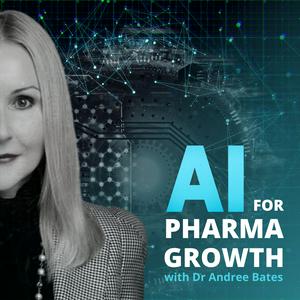
AI For Pharma Growth is the podcast from pioneering Artificial Intelligence entrepreneur Dr. Andree Bates created to help Pharma, Biotech and other Healthcare companies understand how the use of AI-based technologies can easily save them time and grow their brands and company results.
This show blends deep experience in the sector with demystifying AI for biopharma execs from biotech start-ups right through to big pharma. In this podcast, Dr Andree will teach you the tried and true secrets to building results in a pharma company using AI and alert you to some fascinating new tools and applications to benefit you and your company.
As the author of many peer-reviewed journals in pharma AI, and having addressed over 500 industry conferences across the globe, Dr Andree Bates uses her obsession with all things AI, futuretech, healthcare and pharma to help you to navigate through the, sometimes confusing, but magical world of AI powered tools to achieve real-world results.
This podcast features many experts who have developed powerful AI-powered tools that are the secret behind some time-saving and supercharged revenue-generating business results. Those who share their stories and expertise show how AI can be applied to Discovery, R&D, clinical trials, market access, medical affairs, regulatory, market research, business insights, sales, marketing, including digital marketing, and so much more.
Sito web del podcastAscolta AI For Pharma Growth, The Bull - Il tuo podcast di finanza personale e molti altri podcast da tutto il mondo con l’applicazione di radio.it
Scarica l'app gratuita radio.it
- Salva le radio e i podcast favoriti
- Streaming via Wi-Fi o Bluetooth
- Supporta Carplay & Android Auto
- Molte altre funzioni dell'app
Scarica l'app gratuita radio.it
- Salva le radio e i podcast favoriti
- Streaming via Wi-Fi o Bluetooth
- Supporta Carplay & Android Auto
- Molte altre funzioni dell'app

AI For Pharma Growth
Scansione il codice,
scarica l'app,
ascolta.
scarica l'app,
ascolta.
 Italia