

Ascolta questo podcast gratuitamente nell'applicazione: Scarica gratuitamente dall'App Store
radio.it
Sleep timer
Radio preferite
107 episodi
The Queen Who Became a Professional Writer
13/07/2026 | 27 minMarguerite de Navarre is the sister and wife of kings. While coping with being an agent of her brother and navigating the religious turmoil , she still found the time to become a bestselling author and perhaps the "first modern woman."
Sources:
Cholakian, Patricia F. and Rouben C. Marguerite de Navarre: Mother of the Renaissance (Columbia University Press, 2006).
Gristwood, Sarah. “I Wrote a Book About Renaissance Queens. Today’s Stories of Sex Assault Sound Like Something Out of the 16th Century.” History News Network. 3 December 2017. https://www.historynewsnetwork.org/article/i-wrote-a-book-about-renaissance-queens-todays-sto.Last Accessed: 7/9/2026.
Knecht, Robert J. Renaissance Warrior and Patron: The Reign of Francis I (Cambridge University Press, 1994).
For more information, transcripts, and ways to support the show, go to turningmodern.com.The Drop-Out Who Destroyed a Society
06/06/2026 | 21 minIn 1519, Europeans made their first diplomatic contact with an urbanized empire in the Americas—and, within a few years, that empire will no longer exist, in no small part because of a failed law student from Spain.5/30 Update
30/05/2026 | 2 minHere is just a short update on the next episode and the state of the "Turning Modern" Patreon.Turning Modern: Martin Luther on Trial
15/05/2026 | 27 minMartin Luther braves persecution by the Church to come to the city of Worms to have his case heard by Emperor Charles V. In this contest between a reviled monk who is the son of a mine owner and a monarch whose empire spans an ocean, the victor is perhaps not the person one would normally expect...
Sources
Gregory, Brad S. The Unintended Reformation: How a Religious Revolution Secularized Society (Harvard University Press, 2012).
Luther, Martin. Works: Letters I, vol. 48, ed. and trans. Gottfried G. Krodel (Fortress Press, 1963).
Parker, Geoffrey. Emperor: A New Life of Charles V (Yale University Press, 2019).
Roper, Lyndal. Martin Luther: Renegade and Prophet (Penguin Random House, 2016).
For more information, transcripts, and ways to support the show, go to turningmodern.com.The "Journalist" Who Covered the Ottoman Invasion of Egypt
01/05/2026 | 30 minWriting in the years of 1516 and 1517, an inhabitant of Cairo likely witnessed firsthand a new era as Egypt lost its independence and was forcibly annexed by the Ottoman Empire. However, he not only observed the collapse of the old regime, but also the toll it took on the people.
Sources:
Finkel, Caroline. Osman’s Dream: A History of the Ottoman Empire (Basic Books, 2005).
Ibn Iyas. An Account of the Ottoman Conquest of Egypt, trans. W.H. Salmon (Royal Asiatic Society, 1921).
Ibn Iyas. Journal d’un Bourgeois du Caire, ed. and trans. Gaston Wiet (Libraire Armand Colin, 1945).
Lord Kinross. The Ottoman Centuries: The Rise and Fall of the Turkish Empire (HarperCollins, 1979).
Petry, Carl F. The Mamluk Sultanate: A History (Cambridge University Press, 2022).
For more information, transcripts, and ways to support the show, go to turningmodern.com.
Altri podcast di Storia
 8:46Storia
 Il podcast di Alessandro Barbero: Lezioni e Conferenze di StoriaCultura e società, Scolastico, Storia
 The Rest Is HistoryStoria
 Alessandro Barbero Podcast - La StoriaArte, Cultura e società, Libri, Storia
 DisastriCronaca nera, Cultura e società, Documentari, Storia
 You're Dead to MeParodia musicale, Storia
 Qui si fa l'ItaliaCultura e società, Documentari, Storia
 Storia in PodcastStoria
 Troubles - Una Storia IrlandeseCronaca nera, Cultura e società, Documentari, Storia
 Dentro alla storiaStoria
Podcast di tendenza in Storia
 Curiosità della StoriaStoria
 You're Wrong AboutCronaca nera, Cultura e società, Storia
 پادکست رخNarrativa, Storia
 The History PodcastStoria
 L'ombelico di un mondoStoria
 Curiosidades de la Historia National GeographicStoria
 Lezioni di storia con Stefano D'AmbrosioStoria
 American ScandalCultura e società, Documentari, Storia
 La Storia OscuraCronaca nera, Cultura e società, Storia
 In Our Time: CultureStoria
 Geschichten aus der GeschichteCultura e società, Scolastico, Storia
 V come VajontStoria
 Passato ProssimoCronaca nera, Storia
 MovarekhPodcast احمدهاشمیCultura e società, Documentari, Storia
 راوکست | RavcastArte, Cronaca nera, Cultura e società, Libri, Storia
 Le Caporetto degli altriParodia musicale, Storia
 Real Survival StoriesCultura e società, Documentari, Nella natura selvaggia, Sport, Storia
 Storia di Milano: Dalle Origini ai Giorni NostriStoria
 Storia&CulturaCultura e società, Documentari, Scolastico, Storia
 Business HistoryEconomia, Storia
 L'Iliade Per TuttiCultura e società, Documentari, Storia
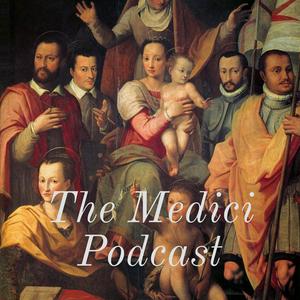
Su The Medici Podcast
The Medici might not have the decadent drama of the Borgias, but they took center stage in the story of the formation of the modern Western world, from helping mold the Renaissance to trying to quell the Protestant Reformation to sponsoring and then trying to help shut up Galileo. This podcast looks at the story of the Medici and that of the fractured, tumultuous Italy they carved out a place in. Join us to see how a clan of middle-class bankers would up joining the ranks of European royalty and leaving a mark on the world.
Website: https://medicipodcast.com/
Venmo: @ Chad-Denton-15
Sito web del podcastAscolta The Medici Podcast, 8:46 e molti altri podcast da tutto il mondo con l’applicazione di radio.it
Scarica l'app gratuita radio.it
- Salva le radio e i podcast favoriti
- Streaming via Wi-Fi o Bluetooth
- Supporta Carplay & Android Auto
- Molte altre funzioni dell'app
Scarica l'app gratuita radio.it
- Salva le radio e i podcast favoriti
- Streaming via Wi-Fi o Bluetooth
- Supporta Carplay & Android Auto
- Molte altre funzioni dell'app

The Medici Podcast
Scansione il codice,
scarica l'app,
ascolta.
scarica l'app,
ascolta.
The Medici Podcast: Podcast correlati
 Italia