
Ascolta questo podcast gratuitamente nell'applicazione: Scarica gratuitamente dall'App Store
radio.it
Sleep timer
Radio preferite
319 episodi
How to Turn Skills Intelligence Into Business Value
27/10/2026 | 50 minYou’ve mapped your workforce’s skills. What changes in the decisions your organisation makes?
In this episode of the Digital HR Leaders podcast, David Green welcomes back Loïc Michel, co-founder and CEO of 365Talents, a Docebo company, to explore how organisations can connect skills intelligence, learning and workforce strategy. From closing capability gaps to redeploying talent and reducing reliance on external contractors, they discuss what it takes to make skills data useful in everyday business decisions. They also explore how AI agents could change the work of HR, and why human judgement remains essential.
Join them as they discuss:
Why learning and skills technology grew up separately, what bringing them together enables
How to measure whether capability gaps are closing through a cycle of detecting, developing and assessing skills
Why skills initiatives stall at the mapping stage, and how a clear business problem and committed leadership keep them moving
How SNCF used skills intelligence to identify internal capabilities and reduce reliance on subcontractors
Where AI agents can support learning and career development, and how to keep people in the lead on workforce decisions
Why understanding skills and tasks is essential to preparing people for changing jobs and work shared with AI agents
This episode is sponsored by 365Talents, a Docebo company.
Every organisation approaches skills in its own way, so 365Talents designs its talent intelligence solutions to adapt to how each business works. HR teams use them to put skills-based strategies into action more quickly and to see the impact across the whole organisation.
Find out more about 365Talents
Building or refining your skills strategy? The 2026 Skills Toolkit brings together 14 free HR templates covering every stage of the journey. It includes a business case built for your CFO, a structured framework for comparing vendors, a strategy you can take to the board, and practical tools for day-to-day HR operations and rollout.
Get free access to the 2026 Skills Toolkit
Resources:
365Talents newsletter
365Talents skills resources
Docebo
Hosted on Acast. See acast.com/privacy for more information.Why Relationships Matter More as AI Reshapes Work
20/10/2026 | 1 h 10 minAs AI makes knowledge more widely available, are organisations paying enough attention to the relationships that help people put it to work?
In this episode of the Digital HR Leaders podcast, David Green is joined by Michael Arena and Greg Pryor, co-founders of the Connected Commons and co-authors of the forthcoming book, The New Social Code: Five Relational Edges That Outperform Algorithms. Drawing on decades of organisational network research and experience leading talent in major organisations, Michael and Greg explore how human connections shape performance, career progression and the ability to turn new ideas into action. Michael is Dean of the Crowell School of Business at Biola University and previously served as Chief Talent Officer at General Motors and VP of Talent at AWS. Greg’s career spans talent leadership and consulting at organisations including Accenture, Workday, Merrill Lynch and Juniper Networks. Together, they make the case for bringing social capital into talent practices alongside skills and experience, helping people build the relationships they need for the work they do today and the responsibilities they may take on tomorrow.
Join them as they discuss:
Why relationships become more important as AI makes knowledge easier to access
The five relational edges: opportunity, trust, attention, insight and influence
Why bigger networks can undermine performance, and how to balance deep trust with broader connections
How onboarding can help new joiners build trust and contribute more quickly
How to recognise collaboration overload and support the people connecting different parts of the organisation
What networks reveal about future leaders, and practical ways to apply this thinking without sophisticated analytics
This episode is sponsored by 365Talents, a Docebo company.
Every organisation approaches skills in its own way, so 365Talents designs its talent intelligence solutions to adapt to how each business works. HR teams use them to put skills-based strategies into action more quickly and to see the impact across the whole organisation.
Find out more about 365Talents
Building or refining your skills strategy? The 2026 Skills Toolkit brings together 14 free HR templates covering every stage of the journey. It includes a business case built for your CFO, a structured framework for comparing vendors, a strategy you can take to the board, and practical tools for day-to-day HR operations and rollout.
Get free access to the 2026 Skills Toolkit
Resources:
The New Social Code: Five Relational Edges That Outperform Algorithms
The New Social Code Compendium Newsletter
Hosted on Acast. See acast.com/privacy for more information.How Roblox Is Rethinking People, Systems and Workforce Strategy
13/10/2026 | 51 minWhat changes when the people function is designed not as a collection of separate HR processes, but as part of the operating system of the company?
In this episode of the Digital HR Leaders podcast, David Green is joined by Jack Buckley, Chief People and Systems Officer at Roblox, to explore how measurement, people analytics, technology and workforce strategy come together inside one of the world’s best-known technology companies.
Jack’s career spans the US Navy, academia, applied statistics, large-scale assessment and game-based hiring before leading people and systems at Roblox. That background has shaped a clear philosophy: before organisations make better people decisions, they need to be confident they are measuring the right things, with data they can trust.
Join them, as they discuss:
Why data quality and measurement should come before advanced analytics
Lessons from building a people science and analytics function during hypergrowth
Why People and Finance need a shared view of workforce data and planning
How the Roblox operating system brings people processes, technology and internal products together
When organisations should buy technology, customise it or build their own
How AI is reshaping recruiting, assessment, performance, retraining and workforce planning at Roblox
Why skills atrophy could become a significant challenge as employees rely more heavily on AI tools
How to balance rapid experimentation with rigorous evaluation and governance
Why measuring the work and skills people actually use is essential to redesigning work and creating business value
This episode is sponsored by 365Talents, a Docebo company.
Every organisation approaches skills in its own way, so 365Talents designs its talent intelligence solutions to adapt to how each business works. HR teams use them to put skills-based strategies into action more quickly and to see the impact across the whole organisation.
Find out more about 365Talents
Building or refining your skills strategy? The 2026 Skills Toolkit brings together 14 free HR templates covering every stage of the journey. It includes a business case built for your CFO, a structured framework for comparing vendors, a strategy you can take to the board, and practical tools for day-to-day HR operations and rollout.
Get free access to the 2026 Skills Toolkit
Resources:
Roblox
Insight222 People Analytics Trends 2025/26
HR Operating Model for the AI Era
Try Roblox's Coding Cookies practice assessment
Hosted on Acast. See acast.com/privacy for more information.How Bank of America and Cornerstone Are Building an AI-Ready Workforce
06/10/2026 | 53 minYour organisation has committed to an AI strategy. But what does that commitment mean for the people who have to work differently because of it?
AI adoption is moving into a more demanding phase. The challenge for HR and learning leaders is translating technology investment into new capabilities, different ways of working and measurable business outcomes.
In this special episode of the Digital HR Leaders podcast, David Green is joined by Mike Wynn, SVP, Academy Executive for AI Capabilities & Enterprise Learning Products at Bank of America, and Himanshu Palsule, CEO of Cornerstone. Together, they explore what it takes to build an AI-ready workforce, combining the practical experience of capability building at scale with a broader perspective on workforce intelligence, skills and work redesign.
Join them as they explore:
How Bank of America is building AI confidence and capability across every career stage, from self-paced learning to collaborative, experiential workshops
Why every AI capability the bank teaches is anchored to human skills such as judgement, critical thinking and strategic thinking
Why organisations need to connect AI strategy with workforce strategy by understanding how work, tasks and skills are changing
How workforce intelligence can help organisations connect signals about people and work with outcomes such as productivity, mobility and workforce transformation
Why learning increasingly needs to happen in the flow of work, as technology makes development more continuous and contextual
Why course completions and attendance are insufficient measures of success, and why leaders should instead look for changes in behaviour, work and business outcomes
What HR and learning leaders should prioritise when ambitious AI plans have yet to translate into a clear people strategy
For CHROs, CLOs and workforce leaders, this conversation offers a practical roadmap for moving beyond AI experimentation and building the workforce capability needed to turn ambition into business value.
This episode is sponsored by Cornerstone.
Industries, organisations and workforces are all changing at once, and most people leaders are trying to respond with fragmented data and processes that move too slowly to keep up. Cornerstone brings together the insights leaders need, the learning and skills that move people forward, and AI agents that turn intelligence into action, helping organisations build a workforce that’s ready for what’s next.
Explore Cornerstone Workforce AI™ and the wider platform here. And if you are building the case internally, Cornerstone's CHRO Mandate eBook on workforce readiness is a useful place to start: CHRO Mandate eBook
Find out more about Cornerstone here.
Resources:
Cornerstone Connect, Chicago
Bank of America Careers
Hosted on Acast. See acast.com/privacy for more information.How to Build an AI-Enabled HR Operating Model
29/09/2026 | 1 h 2 minWhat if the thing slowing down AI in HR isn't the technology at all, but the way the function is set up to deliver it?
Most HR organisations already have access to AI. The bigger challenge is whether the way HR is structured, governed and measured is ready to turn that technology into sustainable business value.
In this episode of the Digital HR Leaders podcast, David Green is joined by Michael Rochelle, Chief Strategy Officer, principal analyst and co-founder of Brandon Hall Group, to explore new research identifying six structural moves for building an AI-enabled HR operating model.
Join them, as they discuss:
Why the operating model can become the constraint on AI transformation, even when the technology is ready
What changes when HR manages recruiting, learning, employee experience and workforce planning as continuously evolving products rather than finite programmes
Why great people and well-designed processes need to come before technology, and the risks of automating processes that already need redesigning
How talent pods, workforce product teams and centres of excellence can combine business proximity with scalable solutions and enterprise standards
Why HR business partners need deeper business acumen and a stronger performance consulting mindset
Why governance works best when it is embedded into design and delivery, helping create the trust required for innovation
Why HR needs to strengthen capabilities in judgement, critical thinking, business acumen and data and analytics as work changes
How leaders can measure business, workforce, system and future impact rather than simply tracking implementation activity
For CHROs and HR leaders rethinking how their function operates, this conversation provides a practical framework for creating an HR model that can continuously adapt, scale and deliver measurable value.
This episode is sponsored by HiBob.
HiBob is the people platform built for the AI era, helping organisations replace fragmented HR systems with a unified foundation for workforce management.
That's why Brandon Hall Group says unified workforce platforms are becoming the foundation for organisations looking to scale AI with confidence.
The report also includes a practical business case template with ROI modelling and executive evaluation criteria to help build your transformation strategy.
Download the Brandon Hall Group HCMS Platforms Report
Resources:
Brandon Hall Group
The AI-Enabled HR Operating Model
Hosted on Acast. See acast.com/privacy for more information.
Altri podcast di Carriere




Podcast di tendenza in Carriere

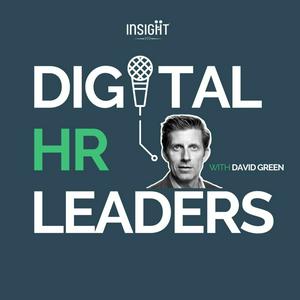
Su Digital HR Leaders with David Green
In this series, David Green will be speaking to a range of senior HR leaders who are pushing a data-driven and digital HR agenda. There is an increasing need for HR professionals to become more digitally and numerically literate – to acquire the skills necessary to process, produce and leverage digital information to create business value. You'll hear from people leaders who are driving transformation in their organisations on how HR can prepare for the future and what HR leaders need to do to prepare for the Future of Work. Hosted on Acast. See acast.com/privacy for more information.
Sito web del podcastAscolta Digital HR Leaders with David Green, Think Fast Talk Smart: Communication Techniques e molti altri podcast da tutto il mondo con l’applicazione di radio.it
Scarica l'app gratuita radio.it
- Salva le radio e i podcast favoriti
- Streaming via Wi-Fi o Bluetooth
- Supporta Carplay & Android Auto
- Molte altre funzioni dell'app
Scarica l'app gratuita radio.it
- Salva le radio e i podcast favoriti
- Streaming via Wi-Fi o Bluetooth
- Supporta Carplay & Android Auto
- Molte altre funzioni dell'app
Digital HR Leaders with David Green
Scansione il codice,
scarica l'app,
ascolta.
scarica l'app,
ascolta.
Digital HR Leaders with David Green: Podcast correlati
 Italia

