
Ascolta questo podcast gratuitamente nell'applicazione: Scarica gratuitamente dall'App Store
radio.it
Sleep timer
Radio preferite
223 episodi
#219 The Columbian Exchange and “the Seams of Pangaea”
12/10/2026 | 50 minThis factoid-rich episode is a major rewriting of one of the earliest and most popular episodes of the podcast, Introduction to the Columbian Exchange, which originally aired on February 12, 2021 and then again in a revised form as episode #166 on October 11, 2024. This version includes lots of new aspects of the Columbian Exchange, and more recent scholarship on several of the topics discussed in the old episodes.
The supercontinent known as Pangaea (Pangea if you are reading most American textbooks) began to split apart around 200 million years ago, near the beginning of the dinosaur era, and the new Atlantic Ocean entirely divided the eastern and western hemispheres about 75 million years ago. Biological life on the two continents probably began evolving separately about 100 million years ago.
That biological diversity enabled by the breaking up of Pangaea has been an enormous boon for homo sapiens as a species in the more than five centuries since October 12, 1492, and also the cause of much suffering for individual humans in both the Americas and the Old World, Africa particularly.
I learned a lot in the rewriting of this – such as the correct scholarly spelling for the name of the supercontinent of old is “Pangaea” – and I hope you do too.
And listen to the end for the controversial takes!
Subscribe to my Substack!
X (new account) @jbhenneman – https://x.com/jbhenneman
Facebook – https://www.facebook.com/HistoryOfTheAmericans
#166 Introduction to the Columbian Exchange (Revised)
Selected references for this episode (Commission earned for Amazon purchases through the website)
Alfred W. Crosby, Jr., The Columbian Exchange: Biological and Cultural Consequences of 1492, 30th Anniversary Edition
Noble David Cook, Born to Die: Disease and New World Conquest, 1492-1650
Charles C. Mann, 1493: Uncovering the New World Columbus Created
Nathan Nunn and Nancy Qian, “The Columbian Exchange: A History of Disease, Food, and Ideas”
Rodrigo Barquera and others, “Ancient genomes reveal a deep history of Treponema pallidum in the Americas,” Nature, December 18, 2024 (subscription required).
Jorge R. Díaz-Valderrama and others, “The History of Cacao and Its Diseases in the Americas,” Phytopathology, September 14, 2020.#218 La Salle, Frontenac, and the Secret Mission for France
05/10/2026 | 35 minIt is the 1670s. Robert Cavelier, Sieur de La Salle, having returned from exploring south of Lake Erie, made common cause with the flamboyant and visionary new governor of New France, Louis de Buade, Comte de Frontenac. Together they hatch a plan to get permission from Louis XIV to build a string of forts in the Great Lakes region and explore and settle the Mississippi River Valley. La Salle travels to France twice, and enlists the King’s first minister, the great Jean-Baptiste Colbert, to support a mission to find the mouth of the Mississippi so that France might establish a base there for the purpose of better harrassing Spain. Along the way La Salle builds a huge fort at the eastern end of Lake … Ontario, survives the second of five assassination attempts, and Frontenac demonstrates a great flair for diplomacy with the Iroquois.
Oh, and the Jesuits have it out for them.
Subscribe to my Substack!
X (new account) @jbhenneman – https://x.com/jbhenneman
Facebook – https://www.facebook.com/HistoryOfTheAmericans
#217 Introduction to René-Robert Cavelier, Sieur de La Salle
Primary references for this episode (Commission earned for Amazon purchases through the episode notes on our website)
Anka Muhlstein, La Salle: Explorer of the North American Frontier
Richard Gross and Craig P. Howard, “Colbert, La Salle, and the Search for Empire,” Journal of the Illinois State Historical Society, Summer 2020.#217 Introduction to René-Robert Cavelier, Sieur de La Salle
27/08/2026 | 43 minIt is time to get back to New France and the exploration of the middle of this beautiful country of ours. Our vehicle will René-Robert Cavelier, Sieur de La Salle, known to both his contemporaries and to history as “La Salle.” You’ve heard his name, especially if you live within driving distance of the Mississippi, but do you know what he actually did? This and the next few episodes tell La Salle’s remarkable story.
We are back in New France, along the St. Lawrence River, now in the 1660s. The episode begins with an introduction to the geopolitics of North America from the French perspective, then pivots to La Salle’s early life and first years in New France, where he had received a grant of land on roughly the site of Montreal’s international airport. Finally, we conclude with his first journey of discovery, an attempt – perhaps fulfilled – to discover the Ohio River, of which he had heard from Seneca Iroquois who wintered with him in 1668-69. This voyage mattered, because it might have established French claims to the Pittsburgh area, the ambiguity of which was, along with George Washington, the catalyst for the French and Indian War. Sadly, those claims were ambiguous because the French national archives had misplaced the relevant narratives, and they only resurfaced in the 19th century. Archivists matter!
Subscribe to my Substack!
X – @TheHistoryOfTh2 – https://x.com/TheHistoryOfTh2
Facebook – https://www.facebook.com/HistoryOfTheAmericans
Primary references for this episode (Commission earned for Amazon purchases through the episode notes on our website)
Anka Muhlstein, La Salle: Explorer of the North American Frontier
Robert S. Weddle, “Tarnished Hero: A La Salle Overview,” The Southwestern Historical Quarterly, Oct. 2009.
Richard Gross, “La Salle’s Claim and the Ohio River Valley,” Pennsylvania History: A Journal of Mid-Atlantic Studies, Spring 2020.#216 William Penn and the Selling of Pennsylvania
05/08/2026 | 31 minIt is the spring of 1681. The “exclusion crisis,” an insurgency in Parliament proposing to exclude the king’s brother, James, Duke of York, from the line of succession, was reaching its climax. Even so, on March 4 King Charles II found time to grant William Penn a vast territory extending from the west bank of the Delaware River to a longitude equal to the then western border of Maryland. It was now William Penn’s role, as sole proprietor of Pennsylvania, to fill it up with people. He would do a remarkable job, especially under the challenging circumstances, relying heavily on his … pen. Along the way he would write a practical and moral defense of English colonialism at a time when many of the movers and shakers in London were arguing against it.
Subscribe to my Substack!
X – @TheHistoryOfTh2 – https://x.com/TheHistoryOfTh2
Facebook – https://www.facebook.com/HistoryOfTheAmericans
Primary references for this episode (Commission earned for Amazon purchases through the episode notes on our website)
Andrew R. Murphy, William Penn: A Life
Jean R. Soderlund (Editor), William Penn and the Founding of Pennsylvania: A Documentary History
Joseph E. Illick, Colonial Pennsylvania: A History
Richard S. Dunn, “William Penn and the Selling of Pennsylvania, 1681-1685,” Proceedings of the American Philosophical Society, Oct. 14, 1983#215 The Founding of Pennsylvania and Some Other Stuff
26/07/2026 | 31 minWith Sir William Penn’s passing in 1671, and his deathbed admonition that his son stay true to himself, young William Penn was both financially independent and liberated from worrying that his own activism on behalf of the Quakers would hurt his family. William now owned lands that generated income of around 2000 pounds a year, or roughly the wages of 100 laborers of the time.
Penn was a pious son of privilege who used his social, material, and intellectual advantages to advance his family’s business interests and the interests of Quakers, both as individuals and as a religious community. He would get tossed in jail at least once more for his religion, and he would use that time writing defenses of the Quakers and their theology that irritated the established church and its supporters to no end. By the second half of the 1670s he had written more than fifty books and pamphlets on religion and political theory, most of which would vex the English elites in general and local authorities in specific cases.
And, yet, by 1681 Penn would persuade King Charles II and his brother, James, Duke of York, to give him, as sole proprietor, an area of 34 million acres, the last land on the eastern seaboard of North America controlled by England.
How the heck did that happen?
Subscribe to my Substack!
Facebook – https://www.facebook.com/HistoryOfTheAmericans
#212 William Penn Before Pennsylvania 1
#214 William Penn Before Pennsylvania 2: Penn on Trial
#210 The Quakers Invade West New Jersey
Primary references for this episode (Commission earned for Amazon purchases through the episode notes on our website)
Andrew R. Murphy, William Penn: A Life
Jean R. Soderlund (Editor), William Penn and the Founding of Pennsylvania: A Documentary History
Joseph E. Illick, Colonial Pennsylvania: A History
Altri podcast di Storia






Podcast di tendenza in Storia



















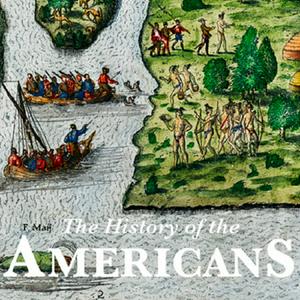
Su The History of the Americans
The history of the people who live in the United States, from the beginning.
Sito web del podcastAscolta The History of the Americans, The Rest Is History e molti altri podcast da tutto il mondo con l’applicazione di radio.it
Scarica l'app gratuita radio.it
- Salva le radio e i podcast favoriti
- Streaming via Wi-Fi o Bluetooth
- Supporta Carplay & Android Auto
- Molte altre funzioni dell'app

 Italia

