
Ascolta questo podcast gratuitamente nell'applicazione: Scarica gratuitamente dall'App Store
radio.it
Sleep timer
Radio preferite
11 episodi
11. Getting started welding: build a shop for $1000 (where we spent and saved)
13/11/2026 | 1 h 18 minThis week we're talking about building a welding workshop with a budget of $1000. The focus here is where to spend more, where to save your money, and having what you need to complete your first welding projects while keeping the entry price relatively low. So here’s what we’d get if we had to start from scratch!
PDF with gear list images and links— https://drive.google.com/file/d/100zgt8ThYkUu_mCa9x3br4l55pOKmgRV/view?usp=sharing
In this episode:
How to set up a functional beginner welding shop for about $1000
What to spend more on, and where to save your money
Safety gear recommendations (respirator, helmet, jacket, gloves, glasses)
Choosing a multi-process welder that does MIG, stick, and lift TIG
Welding table and fixturing options, including making your own clamps
Angle grinder, consumables, and what to spend more or less on
Drill, bits, step bits, and basic measuring tools for a new shop
Trade-offs between higher-amp welders and better supporting tools
What you can realistically build or do with a $1000 setup
Special mention: *Tajima chalk line https://link.amazon/B0dbb8DcZ
Amal's List
*Half Mask P100 Respirator https://link.amazon/B0gAqKhKa
*Safety Glasses https://link.amazon/B05qMxwc9
*Yeswelder Welding Jacket https://link.amazon/B08rEGjDo
*Yeswelder Welding Hood https://link.amazon/B0hnFmDwg
*Tillman Mig Welding Gloves https://link.amazon/B05iIJQOg
*Vevor Vise https://link.amazon/B08RaRync
*Vevor Welding Table https://link.amazon/B08XtXyx1
*Bar Clamp 6 Pack https://link.amazon/B03ukoYTV
*5/8'' Round Bar For Making Clamps https://link.amazon/B08paB3Q5
*Irwin Clamp 2 Pack https://link.amazon/B00wBvgOJ
*Craftsman 1/2'' Drill Cordless https://link.amazon/B067X0BWR
*Cobalt Drill Bit Set https://link.amazon/B079pQeXC
*Bosch Gws8-45 Angle Grinder https://link.amazon/B07TYPJAz
*Grinder Wheel/Cutoff/Flap 26 Pack https://link.amazon/B0dGSSHF1
*Grinder Wire Wheel 2 Pack https://link.amazon/B0itH3D4a
*Carbide Scribe 4 Pack https://link.amazon/B09m93Pyj
*Fastcap Measuring Tape https://link.amazon/B0ebbeLdn
*Irwin Combination Square https://link.amazon/B05t28hIN
*Digital Calipers https://link.amazon/B07q5pvLz
*Digital Angle Finder https://link.amazon/B09pn07vS
*Yeswelder 160 Amp Mig/Stick/Lift Tig https://link.amazon/B05ig9iJv
*Stick Welding Rod 3/32'' 5lb https://link.amazon/B09U9d3QY
*Flux Core Mig Wire .030 https://link.amazon/B0hWN8Vh7
*30 Amp 220v Extension Cord https://www.amazon.com/dp/B0DYP5W4XG/?tag=greenhillfo0a-20
*Mig Gun Consumables https://link.amazon/B0cxvwJVB
*Mig Pliers https://link.amazon/B03ItsGi4
Eric's List
*ARCCAPTAIN 200A Welder https://link.amazon/B01Ywlfry
*YESWELDER Flux Core Wire https://link.amazon/B0ajWoPrn
*Welding Accessories https://link.amazon/B0hNU11sR
*ARCCAPTAIN Helmet https://link.amazon/B0eHQBEQI
*3M Respirator https://link.amazon/B0h0OMyHg
*3M P100 Filters https://link.amazon/B0bd3CuCj
*NoCry Safety Glasses https://link.amazon/B0fdZ317N
*Ear Plugs https://link.amazon/B0i6sYlFx
*Work Table https://link.amazon/B03aKpr1L
*C Clamps https://link.amazon/B0iOluwF6
*Magnets https://link.amazon/B0gyyMxHb
*36" F Clamps https://link.amazon/B0cVC35Tw
*DongCheng Angle Grinder https://link.amazon/B00w37UoO
*Cut Off Wheels https://link.amazon/B0dY9t6X0
*DeWalt Grinding Disc https://link.amazon/B0eY2DOnx
*Drill https://link.amazon/B01oeVcN8
*Drill Bits https://link.amazon/B00qunxd6
*Step Bits https://link.amazon/B0e7yfBhW
*Cutting Oil https://link.amazon/B0a0ZVPpO
*Calipers https://link.amazon/B09Il7Vw4
*Squares https://link.amazon/B0fzBpDQd
*Scribes https://link.amazon/B04hTVPLo
*Komelon Measuring Tape https://link.amazon/B09H39vRr
*Angle Finder https://link.amazon/B0hpNRqj2
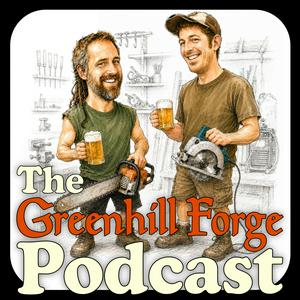
Welcome to the Greenhill Forge Podcast, with Eric from the Greenhill Forge YouTube channel, and my buddy Amal, a fellow builder of many trades.
In this podcast we’ll talk about where the real world meets experiments in alternative energy, wood heating, metal fabrication, off-grid engineering and self sufficiency, so expect discussions about workshops, tools, fabrication, building, homesteading, and what it actually takes to make those dreams real.
We’ll answer a listener question (almost) each week, so send yours to https://forms.gle/zNzKTtjDnBEupLBQA.
WATCH the podcast on Youtube at https://www.youtube.com/@GreenhillPod
LISTEN to this podcast on all your favorite podcast platforms.
See you next Friday!
CHAPTERS
00:00:00 The $1000 beginner welding shop challenge
00:00:52 Amal’s list, starting with safety gear picks and what’s worth spending on
00:08:00 Fixtures, table, and clamps- cheap vs name-brand
00:15:33 Drill and drill bits- where to spend more
00:18:00 Angle grinder and abrasives- name-brand10. Hole-y smokes it’s boring! Making holes in metal
06/11/2026 | 1 h 11 minThis week we’re talking about making holes in metal— twist bits, step bits, annular cutters, hole saws, mag drills, and plasma cutting for steel, plus the tips and techniques for smooth cutting.
In this episode:
Choosing twist drill bits in mild steel, including how to avoid binding or snapping bits
Differences between high-speed steel, cobalt, and coated bits and which we prefer for shop vs. job-site work
Using cutting fluid (oil-based vs. water-based)
How step bits work for enlarging holes and deburring, including practical thickness limits
Using annular cutters (and mag drills) for larger-diameter holes
Hole saws for thin sheet and larger openings, including limitations on precision and thickness
Thermal methods (plasma, laser, oxyacetylene) for cutting holes when drilling isn’t practical
Basic layout, punching, and other ways to keep bits from walking
Alternative approaches for oversized holes (angle grinder, chain drilling, dies, and traditional blacksmithing methods like punching or slitting and drifting)
Practical notes on drill speeds/feeds and reading chip color as a temperature indicator
Listener question on how to get started with alternative fuels for engines
_______________________________
Welcome to the Greenhill Forge Podcast, with Eric from the Greenhill Forge YouTube channel, and my buddy Amal, a fellow builder of many trades.
In this podcast we’ll talk about where the real world meets experiments in alternative energy, wood heating, metal fabrication, off-grid engineering and self sufficiency, so expect discussions about workshops, tools, fabrication, building, homesteading, and what it actually takes to make those dreams real.
We’ll answer a question each week, so send yours to us at https://forms.gle/zNzKTtjDnBEupLBQA
WATCH the podcast on Youtube at https://www.youtube.com/@GreenhillPod
LISTEN on all your favorite podcast platforms.
See you next week!
CHAPTERS
00:00:40 Twist Drill Bits
00:03:54 Drill Bit Materials and Coatings
00:11:13 Cutting Fluid
00:15:03 Step Bits
00:22:53 Annular Cutters
00:32:40 Hole Saws
00:39:23 Plasma, Laser, and Oxyacetylene Cutting
00:43:08 Layout and Center Punching
00:44:37 Alternative Methods for Large Holes
00:51:51 Drill Speeds and Chip Color
01:00:51 Tips of the Week
01:03:32 Listener Question: Getting into Alternative Fuels9. How to survive the Zombie Apocalypse (Happy Halloween!)
30/10/2026 | 1 h 16 minThis week we’re celebrating Halloween by talking about how we’re planning on surviving the hypothetical zombie apocalypse!
In this episode:
Water- practical ways to store and filter it
Rule-of-threes survival priorities and the hardest seasonal months
Best animals for long-term food and work
Community and the need for specialists who produce surplus calories
Food production and calorie-dense crops
Food preservation methods that work without electricity
The importance of salt
Overlooked basics
What we’ll run out of
Mental fortitude, physical fitness, and outdoor practice versus pure gear-based prepping
_______________________________
Welcome to the Greenhill Forge Podcast, with Eric from the Greenhill Forge YouTube channel, and my buddy Amal, a fellow builder of many trades.
In this podcast we’ll talk about where the real world meets experiments in alternative energy, wood heating, metal fabrication, off-grid engineering and self sufficiency, so expect discussions about workshops, tools, fabrication, building, homesteading, and what it actually takes to make those dreams real.
We’ll answer a question each week, so send yours to us at https://forms.gle/zNzKTtjDnBEupLBQA
WATCH the podcast on Youtube at https://www.youtube.com/@GreenhillPod
LISTEN on all your favorite podcast platforms.
See you next week!
CHAPTERS
00:02:49 Water and the rule of threes
00:05:32 Realistic collapse scenarios
00:08:10 Surviving the first two years and lean months
00:09:23 Water storage and filtration
00:15:03 Food storage, cooking, and fuel
00:18:40 Animals for food and work
00:19:55 Community size and specialization
00:22:24 Potatoes, grains, and calorie density
00:22:54 Seed saving and heirloom varieties
00:29:14 Fertilizers, companion planting, and composting
00:30:55 Dentistry and health realities
00:31:38 Food preservation methods
00:36:57 Salt as a critical resource
00:38:58 Clothing, shoes, and textiles
00:46:08 Soap, toilet paper, cordage, and tools
00:49:42 Prepping strategies and location
00:55:34 Communication without modern infrastructure
00:58:45 Mental fortitude and physical fitness
01:12:22 Tips of the Week8. Absorption refrigerator: cooling with fire, water, and salt
23/10/2026 | 1 h 2 minThis week we’re talking about Eric’s recent video on his absorption refrigerator design that uses water as the refrigerant and calcium chloride (road salt) to absorb the vapor, powered by heat instead of a compressor. We’re going through how the cycle works, the main components, the practical limits, and what it takes to keep the system running.
Full Youtube video on fire-powered refrigeration: https://youtu.be/3sv7TBtHcgo?si=qB2NBwEFFEgI2xlk
In this episode:
How an absorption refrigerator cycles water as the refrigerant with calcium chloride as the absorbent
Why calcium chloride is used instead of regular salt or other common absorbents like lithium bromide
The roles of the generator, absorber, condenser, expansion valve, and evaporator
How vacuum lowers the boiling point to produce cooling and why the system stays below ambient pressure
Temperature limits of water as a refrigerant and why making ice is difficult
How the U-bend and pressure differences create directional flow without a compressor
Practical considerations for off-grid use, including supplementing a root cellar and managing heat input
Power needs for pumps and fans, and options for using solar heat on the generator
Challenges with scaling evaporators, absorber capacity, and monitoring pressures and temperatures
Structural and vacuum-related details that affect building and operating the system
_______________________________
Welcome to the Greenhill Forge Podcast, with Eric from the Greenhill Forge YouTube channel, and my buddy Amal, a fellow builder of many trades.
In this podcast we’ll talk about where the real world meets experiments in alternative energy, wood heating, metal fabrication, off-grid engineering and self sufficiency, so expect discussions about workshops, tools, fabrication, building, homesteading, and what it actually takes to make those dreams real.
We’ll answer a question each week, so send yours to us at https://forms.gle/zNzKTtjDnBEupLBQA
WATCH the podcast on Youtube at https://www.youtube.com/@GreenhillPod
LISTEN on all your favorite podcast platforms.
See you next week!
_______________________________
CHAPTERS
00:00:04 Absorption refrigerator design overview
00:01:05 Importance of cooling and off-grid power sources
00:02:36 Choosing water and calcium chloride over other options
00:03:05 How calcium chloride absorbs water vapor in a closed system
00:05:26 Exothermic reaction when calcium chloride hydrates
00:06:30 Calcium chloride as road salt and a concrete accelerator
00:07:47 Water as the refrigerant and the absorber’s role
00:08:08 Cooling the absorber to maintain absorption capacity
00:09:26 Multiple heat cycles compared with vapor compression
00:10:23 Expansion valve, pressure drop, and one-time coolers
00:11:48 Generator and absorber replacing the compressor
00:13:09 Lifting refrigerant with heat and gravity feed
00:13:41 Water’s heat capacity advantages and drawbacks as a refrigerant
00:14:08 Latent heat and phase change explained
00:15:46 Boiling point changes with pressure and elevation
00:16:54 Using vacuum to lower the boiling point for cooling
00:17:58 Freezing limitations of water as a refrigerant
00:19:03 Using the system to supplement a root cellar
00:19:43 Achievable evaporator temperatures and ice-making challenges
00:20:24 Issues with antifreeze additives in the system
00:21:47 Flow through the condenser, needle valve, and evaporator
00:22:05 U-bend as a check valve and pressure separation
00:22:57 Running the generator leg with the valve closed
00:24:18 Split of flow between the evaporator and recirculation
00:27:34 Design process and differences from industrial systems
00:28:00 Sizing the U-bend for the pressure differential
00:29:07 Ambient temperature effects on evaporator performance
00:30:35 Enclosing the evaporator and accounting for fan heat
00:31:45 Adding evaporators in parallel and absorber capacity
00:33:29 Limited published data on calcium chloride as an absorbent
00:36:22 Off-grid challenges with compressors and mechanical energy
00:37:13 Power draw and solar options for heat and pumps
00:39:00 Solar heating the generator and thermal storage ideas
00:41:11 Solar irradiance and concentrating sunlight
00:42:45 Solar panel efficiency versus direct heat collection
00:43:30 Using solar-heated fluid to drive the generator
00:44:37 Potential cooling capacity for small units
00:45:57 Sensors, Arduino modules, and voltage readings
00:48:26 Pressure sensors, absolute versus gauge pressure
00:50:07 System pressures remaining below ambient
00:51:15 Structural deflection and reinforcement under vacuum
00:52:58 Vacuum distillation and related applications
00:56:35 Water level shifts between generator and absorber
01:00:06 Water column acting as a barometer7. Alternative energy alternatives: biofuels & more
16/10/2026 | 1 h 19 minThis week we’re talking about alternative alternative energy — ways to run engines and produce power that aren’t the usual solar panels or wind turbines. We go through waste vegetable oil and biodiesel, wood gasification, small-scale ethanol, methane digesters, and a few mechanical systems like wind pumps, water wheels, trompes, and Stirling engines.
_______________________________
Welcome to the Greenhill Forge Podcast, with Eric from the Greenhill Forge YouTube channel, and my buddy Amal, a fellow builder of many trades.
In this podcast we’ll talk about where the real world meets experiments in alternative energy, wood heating, metal fabrication, off-grid engineering and self sufficiency, so expect discussions about workshops, tools, fabrication, building, homesteading, and what it actually takes to make those dreams real.
We’ll answer a question each week, so send yours to us at https://forms.gle/zNzKTtjDnBEupLBQA
WATCH the podcast on Youtube at https://www.youtube.com/@GreenhillPod
LISTEN on all your favorite podcast platforms.
See you next week!
_______________________________
CHAPTERS
00:00:14 Overview of alternative fuels and mechanical energy systems
00:00:58 Running older diesel engines on waste vegetable oil
00:02:02 Cleaning and filtering waste vegetable oil
00:03:30 Dual-tank veggie oil conversion with preheating and purging
00:05:07 Making biodiesel from waste oil
00:06:35 Sourcing methanol and its cost for biodiesel
00:07:50 Biodiesel compatibility with modern engines and seals
00:09:04 Mixing vegetable oil with diesel or kerosene as a simpler option
00:13:31 Using multi-fuel generators and military equipment on alternative fuels
00:16:41 Filtering methods and removing water from waste oil
00:19:04 Trade-offs between pre-processing fuel and engine complexity
00:23:54 Rebuildable injectors and choosing older mechanical diesel engines
00:27:00 Running tractors and farm equipment on vegetable oil
00:29:25 Do indirect injection diesels handle biofuels better than direct injection
00:31:00 Availability of waste vegetable oil
00:33:46 Wood gasification and producing syngas for gasoline engines
00:35:56 Small-scale ethanol production from sugar or starch crops
00:37:02 Fermentation, distillation process, and energy input vs output
00:40:34 Using solar heat to reduce energy needed for distillation
00:44:00 Dehydrating ethanol with molecular sieves for fuel use
00:46:57 Separating methanol heads and monitoring distillation temperatures
00:50:41 Ethanol yields per acre and the role of farm subsidies
00:53:35 Methane digesters that turn farm waste into burnable gas
00:56:20 Mixing manure, scraps, and fat as digester feedstock
00:57:45 Batch versus continuous digester systems for daily use
01:02:38 Mechanical windmills and water wheels for pumping and workshop power
01:05:07 Using water wheels to grind grain or run equipment
01:06:48 Trompes that use falling water to create low-pressure compressed air for forges
01:10:05 Stirling engines that run on heat differentials
01:13:55 Listener Question: Advice for starting out today
01:17:25 Tips of the Week: Trade school and trying new things
Altri podcast di Casa e giardinaggio







Podcast di tendenza in Casa e giardinaggio




Su The Greenhill Forge Podcast
The companion podcast to the Greenhill Forge YouTube channel, where the experiments meet the real world. Alternative energy, wood heating, metal fabrication, off-grid engineering and homesteading — the workshops, the tools, and what it actually takes to make DIY dreams real.
Sito web del podcastAscolta The Greenhill Forge Podcast, The Minimalists e molti altri podcast da tutto il mondo con l’applicazione di radio.it
Scarica l'app gratuita radio.it
- Salva le radio e i podcast favoriti
- Streaming via Wi-Fi o Bluetooth
- Supporta Carplay & Android Auto
- Molte altre funzioni dell'app
 Italia

