PodcastArteThe Neuroscience of Improvisation

The Neuroscience of Improvisation

Bradley Vines
The Neuroscience of Improvisation
Ultimo episodio

12 episodi

  • The Neuroscience of Improvisation

    Improvisation and Dreaming: Comparing These Intriguing States of Mind and Brain

    27/02/2024 | 15 min
    In this program, we compare dreaming and improvisation focusing on creative synergies, experiential similarities, and the underlying neurophysiology. These states of mind are mutually illuminating. That is, learning about one provides insights into the other. A key insight here is that we can deepen our understanding of improvisation by exploring other states of mind that have overlapping experiential qualities or brain states. In his book Dreams of Awakening, Charlie Morley writes that "…there are many different ways to tell the difference between [different states of experience], but the easiest way to get to grips with these differences is to spend as much time as we can in these states." I propose that this is the case for improvisation, as well. By paying more attention to our dreaming experiences, we may deepen our knowledge of the experience of improvisation.
    References:
    The Case of the Three-Sided Dream: https://tv.apple.com/us/movie/the-case-of-the-three-sided-dream/umc.cmc.2no74bniyii0qtz63oc0wrmih
    Bashwiner, D. (2018). The neuroscience of musical creativity. The Cambridge Handbook of the neuroscience of creativity, 51, 495-516.
    Link to Albert Ayler's New Grass liner notes: https://lavelleporter.com/2010/08/22/message-from-albert-ayler/
    I Called Him Morgan documentary: https://tv.apple.com/us/movie/i-called-him-morgan/umc.cmc.4cip1f47gqxk6qigg0mb1hiny
    Arrows to Infinity documentary: https://tv.apple.com/us/movie/charles-lloyd-arrows-into-infinity/umc.cmc.3ldicyne96kj1hrewd9w3dmvj
    Kansas City PBS documentary Bird: Not Out Of Nowhere | Charlie Parker's Kansas City Legacy: https://www.youtube.com/clip/Ugkx9Z02xiRacQxWEtx5eSmeucx-t6lB5kYZ
    Zadra, A., & Stickgold, R. (2021). When brains dream: Understanding the science and mystery of our dreaming minds. WW Norton & Company.
    Oliver Sach's article about the jazz drummer with Tourette's Syndrome: https://medhum.med.nyu.edu/view/12034
    Hank Green of the SciShow Psych: https://www.youtube.com/watch?v=KwOhfmygHyM
    Braun, A. R., Balkin, T. J., Wesenten, N. J., Carson, R. E., Varga, M., Baldwin, P., ... & Herscovitch, P. (1997). Regional cerebral blood flow throughout the sleep-wake cycle. An H2 (15) O PET study. Brain: a journal of neurology, 120(7), 1173-1197.
    Kraehenmann, R. (2017). Dreams and psychedelics: neurophenomenological comparison and therapeutic implications. Current neuropharmacology, 15(7), 1032-1042.
    Limb, C. J., & Braun, A. R. (2008). Neural substrates of spontaneous musical performance: An fMRI study of jazz improvisation. PLoS one, 3(2), e1679.
    Liu, S., Chow, H. M., Xu, Y., Erkkinen, M. G., Swett, K. E., Eagle, M. W., ... & Braun, A. R. (2012). Neural correlates of lyrical improvisation: an fMRI study of freestyle rap. Scientific reports, 2(1), 834.
    Rosen, D. S., Oh, Y., Erickson, B., Zhang, F. Z., Kim, Y. E., & Kounios, J. (2020). Dual-process contributions to creativity in jazz improvisations: An SPM-EEG study. NeuroImage, 213, 116632.
    Walker, M. P., & van Der Helm, E. (2009). Overnight therapy? The role of sleep in emotional brain processing. Psychological bulletin, 135(5), 731.
    Trehub, S. E., Ghazban, N., & Corbeil, M. (2015). Musical affect regulation in infancy. Annals of the New York Academy of Sciences, 1337(1), 186-192.
    Shenfield, T., Trehub, S. E., & Nakata, T. (2003). Maternal singing modulates infant arousal. Psychology of music, 31(4), 365-375.
    Terry, P. C., Karageorghis, C. I., Curran, M. L., Martin, O. V., & Parsons-Smith, R. L. (2020). Effects of music in exercise and sport: A meta-analytic review. Psychological bulletin, 146(2), 91.
    Seppälä, E., Bradley, C., & Goldstein, M. R. (2020). Research: Why breathing is so effective at reducing stress. Harvard Business Review. Diakses dari https://hbr. org/2020/09/research-why-breathing-is-so-effective-at-reducing-stress. https://hbr.org/2020/09/research-why-breathing-is-so-effective-at-reducing-stress
  • The Neuroscience of Improvisation

    What do improvisation, dreaming, and psychedelics have in common from a neuroscience perspective?

    22/02/2024 | 12 min
    What is the experience of improvisation and what are its neurobiological correlates? One way to flesh out an answer, or at least to get the lay of the land, so to speak, is to look at how improvisation compares with other kinds of brain states and states of experience that have been explored with science, such as dreaming and psychedelics. That's what we're embarking upon here. In this video, you are going to discover that there are some quite interesting relationships between what's happening in the brain during improvisation and what happens to the brain under the influence of dreaming and classical psychedelics.
    References:
    Rinpoche, Tenzin Wangyal. Tibetan Yogas of Dream and Sleep, The (p. 9). Shambhala. Kindle Edition. 
    Seth, A. (2021). Being you: A new science of consciousness. Penguin.
     
    Ramachandran, V. S., & Rogers-Ramachandran, D. (2000). Phantom limbs and neural plasticity. Archives of neurology, 57(3), 317-320.
    Braun, A. R., Balkin, T. J., Wesenten, N. J., Carson, R. E., Varga, M., Baldwin, P., ... & Herscovitch, P. (1997). Regional cerebral blood flow throughout the sleep-wake cycle. An H2 (15) O PET study. Brain: a journal of neurology, 120(7), 1173-1197.
    Kraehenmann, R. (2017). Dreams and psychedelics: neurophenomenological comparison and therapeutic implications. Current neuropharmacology, 15(7), 1032-1042.
    Petri, G., Expert, P., Turkheimer, F., Carhart-Harris, R., Nutt, D., Hellyer, P. J., & Vaccarino, F. (2014). Homological scaffolds of brain functional networks. Journal of The Royal Society Interface, 11(101), 20140873.
    Carhart-Harris, R. L., Leech, R., Hellyer, P. J., Shanahan, M., Feilding, A., Tagliazucchi, E., ... & Nutt, D. (2014). The entropic brain: a theory of conscious states informed by neuroimaging research with psychedelic drugs. Frontiers in human neuroscience, 20.
    Dolan, D., Jensen, H. J., Mediano, P. A., Molina-Solana, M., Rajpal, H., Rosas, F., & Sloboda, J. A. (2018). The improvisational state of mind: A multidisciplinary study of an improvisatory approach to classical music repertoire performance. Frontiers in psychology, 9, 1341.
    Neuroscience of Improvisation video on changes in prefrontal cortex activation associated with improvisation:  https://youtu.be/_lcaXsuDRIw
    Tagliazucchi E., Carhart-Harris R., Leech R., Nutt D., Chialvo D.R. Enhanced repertoire of brain dynamical states during the psychedelic experience. Hum. Brain Mapp. 2014;35(11):5442–5456. [http://dx.doi.org/10.1002/hbm.22562]. [PMID: 24989126]. [PMC free article] [PubMed] [Google Scholar] [Ref list]
    https://arxiv.org/pdf/1405.6466.pdf
    Muthukumaraswamy, S. D., Carhart-Harris, R. L., Moran, R. J., Brookes, M. J., Williams, T. M., Errtizoe, D., ... & Nutt, D. J. (2013). Broadband cortical desynchronization underlies the human psychedelic state. Journal of Neuroscience, 33(38), 15171-15183.
  • The Neuroscience of Improvisation

    How do neuroscience findings compare with the intuitions of great improvisers?

    31/12/2023 | 13 min
    This episode shares overviews of seminal neuroimaging studies that provide insights into what happens in the brain during improvisation. You will learn how these findings align with what improvisers say about their experiences, including remarks from Bill Evans, Sonny Rollins, Kenny Werner, Pat Metheny, and Gary Burton. Cross-cultural perspectives are included here, as well, including reference to a traditional Japanese visual art form and traditional perspectives from West Africa.
     
    References for the episode:
    Kind of Blue liner notes by Bill Evans: http://albumlinernotes.com/Kind_of_Blue.html
     
    Saxophone Colossus documentary about Sonny Rollins: https://www.imdb.com/title/tt0196073/
     
    Full interview with Kenny Werner: https://www.youtube.com/watch?v=qsPg5lu4WCg&t=2318s
     
    Pat Metheny at the Society for Neuroscience conference in 2018: https://youtu.be/yhAbNv1gJT8?si=uMgB-MxmrciyKBAN
     
    Gary Burton's Improv Class: https://youtu.be/t2txO_u2eNg?si=CBd6uc52UqxBOYz6
     
    Limb & Braun, 2008: https://journals.plos.org/plosone/article?id=10.1371/journal.pone.0001679
     
    Liu et al., 2012: https://www.nature.com/articles/srep00834
     
    Rosen et al., 2020: https://www.sciencedirect.com/science/article/pii/S1053811920301191
     
    Rosen et al., 2016: https://www.frontiersin.org/articles/10.3389/fnhum.2016.00579/full
     
    Malidoma Somé: The Ancestors' Gift of Healing: https://youtu.be/io28LgxYRf0?si=9ZX63gP4qtiI3s7t
  • The Neuroscience of Improvisation

    Playbook for Acquiring the Language of Improvisation, with drummer and educator Sammy Miller

    12/12/2023 | 42 min
    In this episode, we have the pleasure of chatting with the marvelous Sammy Miller, the founder of Playbook, which is a groundbreaking approach to teaching improvisation and musical skills. Playbook blends in-person learning with cutting-edge software to foster foundational skills that nourish life-long musical engagement. Sammy is an accomplished Juilliard-trained jazz drummer and a passionate educator. He is on a mission to make music accessible to everyone. In our conversation, we explore his journey, from what sparked his love of music to the creation of Playbook. According to Sammy, Playbook isn't just about learning to play an instrument; it's a dynamic method that empowers individuals to embrace the language of music and to communicate fluently through their art. From classrooms to online spaces, Sammy is paving the way for a new era of musical education that resonates with aspiring musicians and seasoned pros alike.
    For more information about Sammy Miller and Playbook, visit the following websites: https://www.sammymillercongregation.com/playbook
    https://www.thisisplaybook.com/
  • The Neuroscience of Improvisation

    Improvisation and The Attainment of Excellence, with Carnatic Percussionist Dr. Suresh Vaidyanathan

    06/09/2023 | 34 min
    Our guest for this episode is Dr. Suresh Vaidyanathan, who is widely recognized as Ghatam Suresh. He is an extraordinary Carnatic Indian classical percussionist renowned for his mastery of the ancient Ghatam, a clay pot with distinctive resonant and percussive qualities. This instrument plays a pivotal role in Carnatic music as accompaniment and soloist. With a global presence as a leader and collaborator with world-class musicians, Dr. Vaidyanathan brings a unique perspective to the intersection of improvisation and musical expertise. Beyond his exceptional musical talents, Ghatam Suresh is a remarkable teacher known for his creativity and generosity as an exponent of rhythmic knowledge. He is also a scholar and recently completed his doctoral studies on the history of the Ghatam and its performance traditions! Dr. Vaidyanathan imparts invaluable insights into developing musical expertise through improvisation in this first installment of our enlightening conversation. He shares how his intellectual pursuits have enriched his musicianship and unveils his secrets to maintaining and nurturing the quality of mind required to excel in the world of music and the responsibility musicians hold to themselves and their audience. Join us as we delve into the fascinating world of Dr. Ghatam Suresh Vaidyanathan—a musician, scholar, and delightful person.
     
    The musical interlude towards the beginning of the program features music composed and performed by Bradley Vines on alto and baritone saxophones. The first quote is by Louis Kahn taken from the documentary My Architect created by his son, Nathanial Kahn (https://www.amazon.com/My-Architect-Region-2/dp/B0006GVJLC/ref=sr_1_8?crid=2354GLU7P6J5Q&keywords=my+architect+nathaniel+kahn&qid=1693952870&sprefix=my+architect+nathaniel+kah%2Caps%2C439&sr=8-8). The second quote is by Joseph Goldstein from an interview for the Waking Up app (https://rss.samharris.org/feed/24802f09-a945-445c-8d45-81112d77276f).
     
    There are four segments of Ghatam Suresh's performances taken from four different YouTube videos: 
     https://www.youtube.com/watch?v=Re5h3EetEjw
    https://www.youtube.com/watch?v=sCdLXwoMsF8
    https://www.youtube.com/watch?v=wuEmHBKUMCA
    https://www.youtube.com/watch?v=CkmCrGJlNe4
     
    The audio for this episode was edited by Zeyn Mroueh.
Altri podcast di Arte
Su The Neuroscience of Improvisation
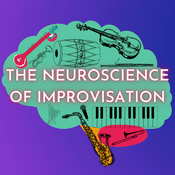
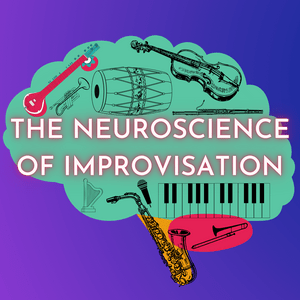
This program explores the neurobiology of improvisation and related topics, such as music, meditation, dreaming, psychedelics, consciousness, and behavior change, with science-based insights into deepening your practice of improvisation. The host, Bradley Vines, is a neuroscientist specializing in music and a saxophonist.
Sito web del podcast

Ascolta The Neuroscience of Improvisation, Copertina e molti altri podcast da tutto il mondo con l’applicazione di radio.it

Scarica l'app gratuita radio.it

  • Salva le radio e i podcast favoriti
  • Streaming via Wi-Fi o Bluetooth
  • Supporta Carplay & Android Auto
  • Molte altre funzioni dell'app